Staying Connected in Antarctica: An eSIM and Wi--Fi Guide
Navigating the unique connectivity challenges of the White Continent, from limited satellite Wi-Fi on expedition ships to the few pockets of mobile service.
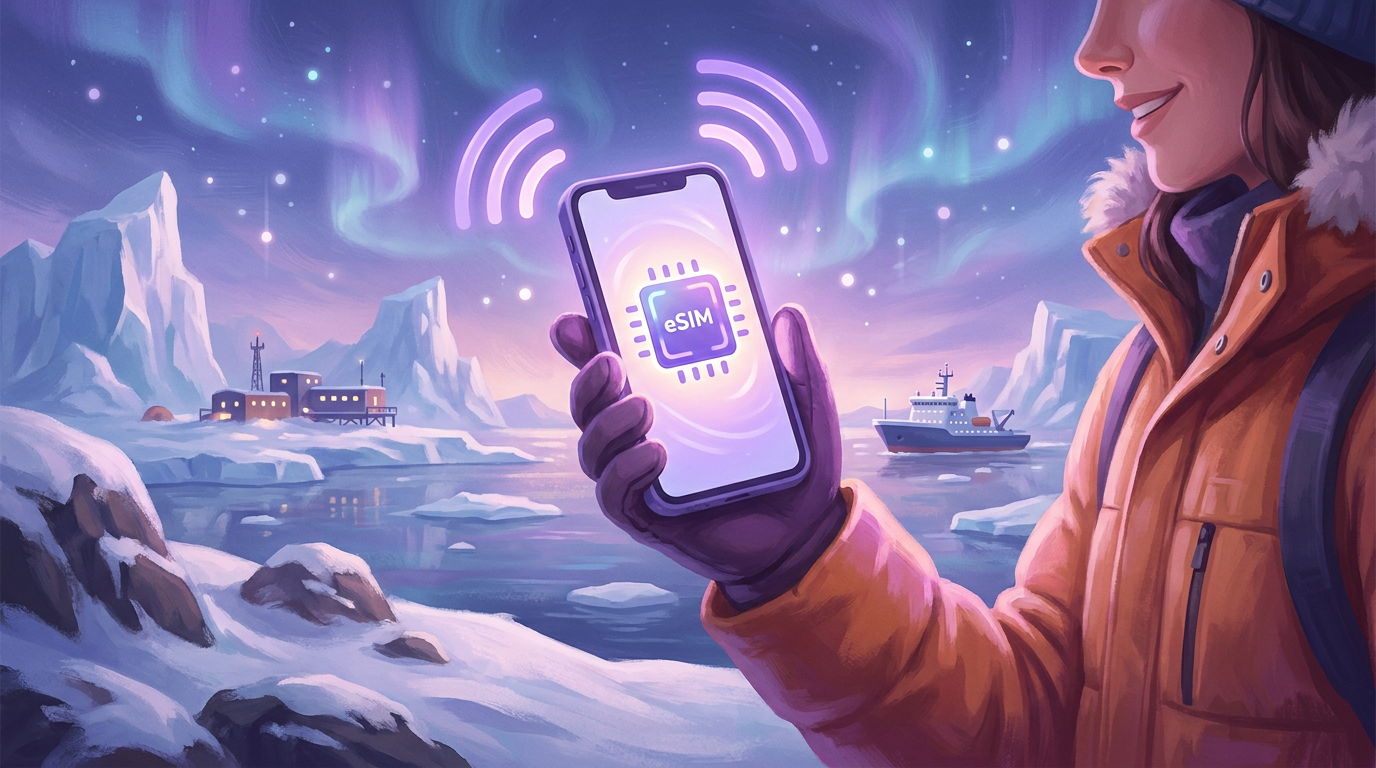
A journey to Antarctica is often described as a trip to another world, and that extends to its digital landscape. On a continent with no permanent population and an environment dedicated to science and preservation, connectivity is a luxury, not a given. Unlike any other destination, there is no nationwide infrastructure for internet or mobile data. All communication with the outside world relies on satellites, which has significant implications for travelers hoping to share their experiences in real-time.
Understanding Connectivity at the End of the World
The first thing to understand is that internet access in Antarctica is slow, expensive, and often unreliable. The vast distance and extreme weather conditions mean that high-speed, broadband-style internet is simply not feasible. Connections are beamed from satellites orbiting the Earth to receivers on expedition ships and research bases. This process introduces high latency (a delay in data transfer), meaning even simple web pages can take a long time to load. Service can be further disrupted by rough seas, ice formations, or the ship's location in narrow channels or deep fjords.
For most visitors, the expedition ship is their home, hotel, and transport. It is also their only source of connectivity. Nearly all modern expedition vessels offer some form of satellite Wi-Fi, but it comes at a price. It's crucial to manage your expectations; this is not the Wi-Fi you are used to at home or in a hotel. The primary purpose is to allow for essential communication, like sending a short email or a text-based message to let loved ones know you are safe.
Wi-Fi on Expedition Ships and Research Stations
Shipboard Wi-Fi is almost always a paid service. Pricing models vary widely between cruise operators. Some offer packages based on data volume (e.g., 100MB, 500MB, 1GB), while others might offer time-based access (e.g., 24 hours) or a single package for the entire voyage. Costs can be substantial, so be sure to check with your specific cruise line before you depart. Some luxury operators may include a basic level of internet access in the cruise fare. Regardless of the cost, the service is generally only suitable for checking emails (without large attachments) and using messaging apps in text-only mode. Streaming video, making video calls, or uploading large photo albums is typically impossible and often blocked by the ship's network administrators to preserve bandwidth for all passengers.
While some research stations have robust internet for their scientific work, this is rarely shared with tourists. At certain landing sites, such as Port Lockroy with its famous post office, you may find a very limited or paid Wi-Fi service. However, these opportunities are rare and shouldn't be counted on. The connection is often slower than on the ship and may be congested with other visitors trying to use it simultaneously.
Mobile Networks and Roaming in Antarctica
Antarctica has no continent-wide mobile network. However, a few isolated cell towers exist, primarily to serve the personnel of national research stations. For example, Argentina's Marambio Base on Seymour Island has a 3G tower operated by an Argentine provider. Similarly, Chile's Frei Station on King George Island has coverage from a Chilean provider. If your ship passes close enough to these locations, your phone might briefly connect to a network.
This is where international roaming can become a problem. Your home provider may have a roaming agreement with these Argentine or Chilean networks, and your phone might connect automatically. The rates for this 'extreme' roaming can be exceptionally high, leading to significant, unexpected charges on your next bill. Given that the coverage is fleeting and unpredictable, relying on roaming is both impractical and financially risky. Most seasoned travelers recommend keeping your phone in airplane mode for the duration of the Antarctic portion of the trip.
The Smart Role of an eSIM for Antarctic Travel
While a dedicated eSIM for the continent of Antarctica doesn't exist due to the lack of networks, an eSIM is an invaluable tool for the journey. Most Antarctic expeditions begin and end in gateway cities like Ushuaia in Argentina or Punta Arenas in Chile. Connectivity in these cities is essential for last-minute arrangements, downloading offline maps and entertainment, contacting your expedition operator, and letting family know your detailed itinerary before you head into the digital silence.
Using a SimMaxi eSIM for Argentina or Chile allows you to get connected the moment you land, avoiding the hassle of finding a local SIM card shop. You can manage your travel plans, check in for your expedition, and send final messages before you lose consistent connectivity. It provides a seamless, stress-free start and end to your polar adventure, ensuring you're connected when it matters most—before and after your time on the ice.
For security, especially when using shared ship Wi-Fi, a VPN (Virtual Private Network) can be useful. It encrypts your data, protecting your passwords and personal information from being intercepted on an unsecured network. While censorship is not a concern in Antarctica itself, a VPN adds a valuable layer of privacy and security to your limited online activity.
In Antarctica, the best connection is often the one you make with the landscape around you. Prepare for a digital detox and embrace the disconnect.
Stay connected when you land
With a SimMaxi eSIM, you can get online without hunting for a physical SIM card.